Best Supply Chain Collaboration Software in 2026: 7 Platforms Compared
Compare the best supply chain collaboration software for 2026: SAP SCC, Coupa, Oracle, Kinaxis, o9, Blue Yonder and e2open by features, cost and ERP fit.
Choosing supply chain collaboration software is harder than it looks. Most "top 10" lists mix ERPs, planning tools and supplier portals together, rank them by review scores, and never answer the question buyers actually ask: which platform will my suppliers really use, and how well does it fit my ERP?
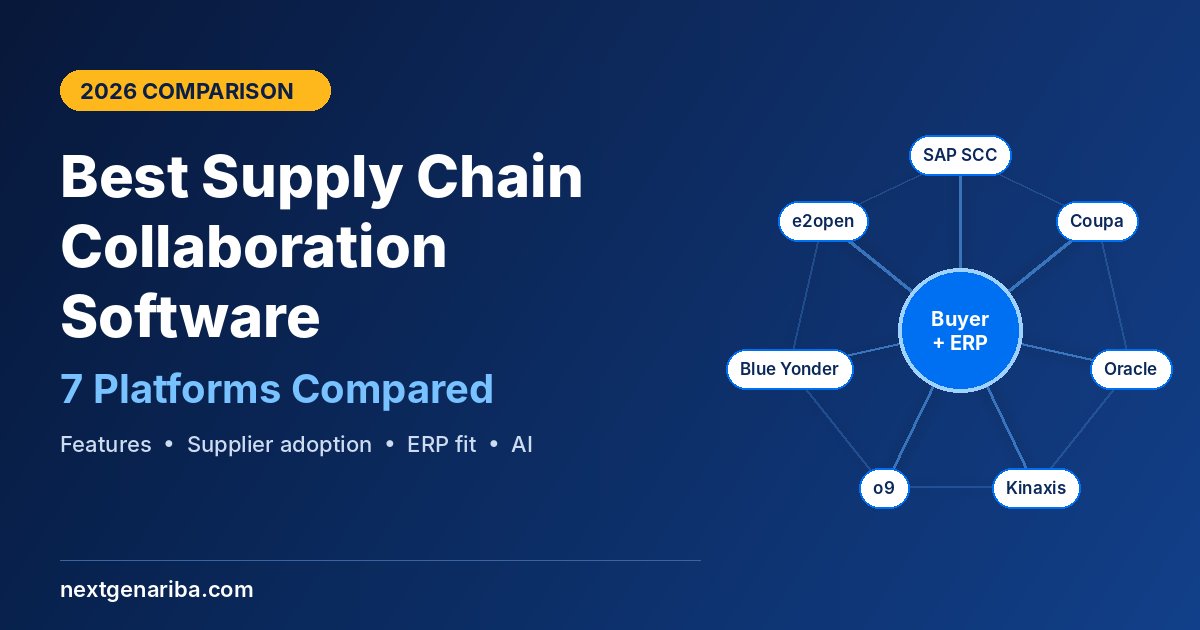
This guide compares the 7 platforms that come up most often in direct-materials collaboration projects in 2026, using the criteria that decide success in real implementations: process coverage, supplier adoption, ERP integration and AI.
Quick answer: If you run SAP S/4HANA or ECC, start with SAP Business Network Supply Chain Collaboration (SCC). If you need collaboration tightly linked to advanced planning, look at Kinaxis or o9. If you are a Coupa or Oracle shop, their native collaboration modules are usually the shortest path.
Comparison table: supply chain collaboration software in 2026
| Platform | Best for | Core strength | Supplier cost | ERP fit |
|---|---|---|---|---|
| SAP Business Network SCC | SAP S/4HANA / ECC manufacturers | Widest standard process coverage + large existing supplier network | Standard account free | Native SAP; other ERPs via integration |
| Coupa Supply Chain Collaboration | Coupa customers, mixed-ERP landscapes | AI-assisted PO collaboration (reads supplier emails) | Free portal | ERP-agnostic, works without Coupa P2P |
| Oracle Supply Chain Collaboration | Oracle Fusion Cloud SCM users | Forecast, VMI and multitier data sync | Portal included | Native Oracle Fusion |
| Kinaxis Maestro | Planning-led, fast-changing supply chains | Concurrent planning with supplier commits | Varies | Connects to any ERP |
| o9 Solutions | Enterprises unifying planning + supplier collaboration | Collaborative triage rooms, tariff/cost collaboration | Varies | ERP-agnostic |
| Blue Yonder (One Network) | Multi-party networks incl. carriers & 3PLs | Real-time multi-enterprise network | Varies | ERP-agnostic |
| e2open (WiseTech Global) | Logistics-heavy, multi-tier networks | Large connected trading-partner and carrier network | Varies | ERP-agnostic |
Pricing for buyers is quote-based for every vendor above. Always confirm supplier-side fees in writing during selection.
What to look for before you compare vendors
Feature lists look almost identical across vendors. These five questions separate them:
- Process coverage. Which processes do you need on day one? Typical scope: forecast collaboration, purchase order confirmation, advance ship notices (ASNs), inventory collaboration (VMI/SMI), consignment, quality notifications, subcontracting, and invoicing.
- Supplier adoption. A platform is only as good as the number of suppliers who use it. Check how many of your suppliers are already on the network, whether a free portal is available, and whether small suppliers can work by email or Excel upload.
- ERP integration. Ask for standard, pre-built integration with your ERP version, not a custom project. Find out who owns mapping and monitoring after go-live.
- Exception management and AI. Look for alerts on late confirmations, forecast commit gaps and shortage risk, plus AI that helps planners act on exceptions instead of reading every document.
- Total cost. Include buyer licences, supplier fees, integration build, and the internal effort needed to onboard suppliers. Supplier enablement is often the largest hidden cost.
1. SAP Business Network Supply Chain Collaboration (SCC)
Best for: manufacturers running SAP S/4HANA or SAP ECC.
SAP SCC (formerly part of SAP Ariba, and the successor to on-premise SAP SNC) connects your SAP ERP directly with suppliers and contract manufacturers on SAP Business Network. It covers the broadest standard set of direct-materials processes: forecasts, POs and scheduling agreements, ASNs, VMI/SMI, consignment, quality, subcontracting, returns and invoices.
Strengths
- Standard integration with S/4HANA and ECC, with no master data replication
- Many suppliers already have an SAP Business Network account, which speeds up onboarding
- Suppliers can connect through the web portal, Excel/CSV upload, EDI or full system integration
- Joule and AI capabilities are being added across SAP Business Network and procurement
Watch-outs
- Enterprise (fully integrated) supplier accounts can carry network fees, so explain this to suppliers early
- Configuration choices (transaction rules, tolerances) need careful fit-to-standard design
For a deep dive, read our SAP Business Network SCC complete guide.
2. Coupa Supply Chain Collaboration
Best for: companies already using Coupa, or mixed-ERP landscapes that want a neutral layer.
Coupa covers PO, forecast, inventory and quality collaboration, plus scheduling, order tracking and consigned-inventory matching. A standout feature is AI that reads supplier email replies, matches them to PO lines and confirms or flags changes, which helps with suppliers who will never log into a portal.
Strengths: free unified supplier portal, AI-driven exception processing, can be implemented without Coupa P2P. Watch-outs: for SAP-centric manufacturers, integration and process depth (e.g. subcontracting with SAP components) should be validated in a demo using your own scenarios.
3. Oracle Supply Chain Collaboration
Best for: organisations on Oracle Fusion Cloud SCM.
Oracle offers forecast collaboration with supplier commits that flow into supply planning, vendor-managed inventory for consigned and unconsigned materials, a supplier portal, B2B transaction management and multitier data synchronisation.
Strengths: native to Oracle Fusion, strong forecast-to-plan loop, REST services for real-time status. Watch-outs: best value is inside the Oracle ecosystem; non-Oracle ERP users will face more integration work.
4. Kinaxis Maestro
Best for: volatile, high-mix supply chains where planning speed matters most.
Kinaxis is a supply chain planning leader; its Maestro platform brings supplier commits and capacity into concurrent planning, so planners can see the impact of a supplier change immediately.
Strengths: planning-first, what-if scenarios, fast response to disruption. Watch-outs: it is a planning platform first. You may still need a transactional network (for POs, ASNs and invoices) alongside it.
5. o9 Solutions
Best for: enterprises consolidating demand, supply and supplier collaboration on one planning platform.
o9's supplier collaboration covers forecast and capacity collaboration, order and inventory collaboration, and tariff and cost collaboration. Its "collaborative triage rooms" bring the data and decisions for an issue, such as demand exceeding capacity, into one workspace. Requests within agreed thresholds can be committed automatically.
Strengths: strong management by exception, tariff and cost scenarios, AI-powered planning. Watch-outs: a broad platform; scope carefully to avoid a long programme.
6. Blue Yonder (One Network)
Best for: multi-party networks that include carriers, logistics providers and contract manufacturers.
Blue Yonder acquired One Network Enterprises in 2024 to build a real-time, multi-enterprise network. Trading partners share inventory and goods movement as it happens, with dedicated networks for suppliers/shippers and carriers/LSPs.
Strengths: end-to-end visibility from supplier to delivery, large partner community. Watch-outs: best fit when you also use Blue Yonder planning or execution tools.
7. e2open (now part of WiseTech Global)
Best for: logistics-heavy, multi-tier supply chains.
WiseTech Global completed its acquisition of e2open in 2025. e2open connects a large network of suppliers, manufacturers, carriers and logistics providers, with strong channel and logistics collaboration.
Strengths: broad trading-partner and carrier network, multi-tier visibility. Watch-outs: watch the product roadmap as the platform is integrated into WiseTech's portfolio.
Which platform should you choose?
| Your situation | Shortlist |
|---|---|
| SAP S/4HANA or ECC, direct materials, many suppliers | SAP Business Network SCC |
| Coupa already in place, or several ERPs | Coupa, SAP SCC |
| Oracle Fusion Cloud SCM | Oracle Supply Chain Collaboration |
| Planning agility is the top priority | Kinaxis, o9 (plus a transactional network) |
| Logistics and carriers are central | Blue Yonder, e2open |
A practical rule: keep the transactional collaboration (POs, ASNs, invoices) close to your ERP, and add a planning platform on top only if planning is your real bottleneck. Running two supplier portals for the same suppliers is the fastest way to lose adoption.
5 mistakes to avoid when selecting collaboration software
- Buying on demos, not your scenarios. Give vendors 3–5 of your real scenarios (a scheduling agreement, a partial ASN, a subcontracting order) and score them on those.
- Ignoring supplier fees. Suppliers push back when fees appear after go-live. Clarify them during selection.
- Underestimating supplier enablement. Budget people and time for onboarding waves, training and support.
- Starting with every process. Go live with PO and ASN collaboration first, then add forecasts, VMI and quality.
- No baseline KPIs. Measure PO confirmation rate, ASN accuracy and OTIF before go-live so you can prove ROI. See our supplier collaboration KPIs and 90-day plan.
New to the topic? Start with what supply chain collaboration is, its types and benefits.
Frequently asked questions
What is supply chain collaboration software?
It is a cloud platform where buyers and suppliers exchange and confirm forecasts, purchase orders, ship notices, inventory, quality and invoice data in real time, connected to the buyer's ERP.
What is the best supply chain collaboration software for SAP users?
For SAP S/4HANA and ECC customers, SAP Business Network Supply Chain Collaboration is usually the best fit because it offers standard ERP integration and many suppliers are already on SAP Business Network.
Is SAP SCC free for suppliers?
Suppliers can use a free standard account on SAP Business Network. Enterprise accounts with full integration may carry fees depending on transaction volume, so confirm the details for your supplier base.
What is the difference between supply chain planning and supply chain collaboration software?
Planning software (such as Kinaxis or o9) decides what to make and buy. Collaboration software executes and confirms it with suppliers. Many companies need both, connected.
How long does a supply chain collaboration implementation take?
A focused first phase with PO and ASN collaboration for a pilot supplier group typically takes 3–6 months, followed by onboarding waves and additional processes.
Next steps
Shortlisting supply chain collaboration software, or already on SAP and planning an SCC rollout? Next Gen Ariba helps manufacturers with SAP Ariba implementation, integration and support and procurement transformation. Book a free consultation to review your scenarios and supplier base.