SAP Ariba Guided Sourcing vs. Classic Sourcing: Key Differences & Migration Guide (2026)
SAP Ariba Guided Sourcing vs Classic Sourcing: key differences, template migration, the mandatory transition and a step-by-step checklist.
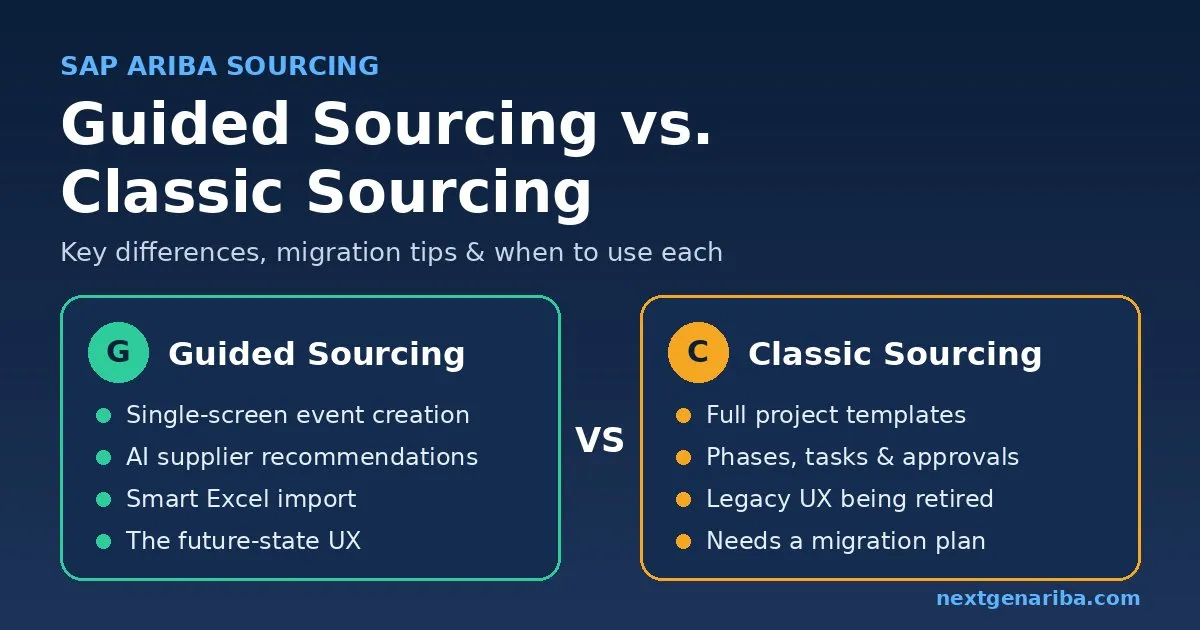
If you run sourcing events in SAP Ariba, you have probably heard that the classic sourcing experience is on its way out. SAP Ariba Guided Sourcing is now the standard way to create and run RFx events, and SAP has been moving customers off the classic UX through a mandatory transition. So what actually changes for buyers, category managers and Ariba admins?
This guide compares SAP Ariba Guided Sourcing vs. Classic Sourcing side by side: how each works, the key differences, what happens to your templates, and a practical checklist for a smooth migration.
What Is Classic Sourcing in SAP Ariba?
Classic Sourcing is the original SAP Ariba Sourcing user experience. It is built around sourcing projects, which come in two flavours:
- Full projects – a structured workspace with phases, tasks, team members, documents, approvals and one or more events inside it. Ideal for long, strategic sourcing initiatives.
- Quick projects – a lighter wrapper around a single event (RFI, RFP, RFQ or auction) for simpler buys.
Classic Sourcing is powerful and highly configurable, but it is also known for a steep learning curve. Buyers navigate many tabs and multi-step wizards to build one event, and occasional users often need help from a sourcing specialist or admin.
What Is SAP Ariba Guided Sourcing?
SAP Ariba Guided Sourcing is the modern user experience for SAP Ariba Sourcing, introduced in 2021. It is not a completely new product – it is a new, simplified UI and set of intelligent features built on top of the proven Classic Sourcing engine.
The idea is simple: guide the buyer through event creation on a single, intuitive screen, so both expert sourcing managers and occasional buyers can launch compliant events quickly. Key capabilities include:
- Single-screen event creation – define suppliers, line items, questions, rules and timelines in one flow.
- Smart import from Excel – upload line items from a spreadsheet; the system detects columns and maps them to master data, and improves with use.
- Recommended suppliers – machine learning suggests suppliers based on commodity and region history.
- Multi-round RFx – run sequential rounds to shortlist suppliers or line items before the next round.
- Built-in scoring and award analysis – compare bids and create awards in a cleaner, more visual interface.
- Contextual help and search – guidance appears where the buyer needs it, reducing training effort.
- Integration with SAP S/4HANA – sourcing requests can flow in from S/4HANA and awards can flow back as contracts or purchase orders (depending on your integration setup).
Guided Sourcing vs. Classic Sourcing: Key Differences
| Area | Classic Sourcing | Guided Sourcing |
|---|---|---|
| User experience | Multi-tab, wizard-based UI | Modern, single-screen guided flow |
| Target users | Sourcing experts and power users | Experts and occasional buyers |
| Structure | Full and quick sourcing projects | Guided events on a simplified project workspace |
| Event creation speed | Slower, many steps | Faster – SAP partners report up to ~50% quicker RFx creation |
| Line item entry | Manual entry or standard Excel import | Smart Excel import with auto-mapping |
| Supplier discovery | Manual search and selection | AI-driven supplier recommendations |
| Multi-round events | Configured manually | Built-in multi-round RFx |
| Templates | Full and quick project templates | Guided sourcing templates (full templates need review) |
| Innovation | Maintenance only | Where all new SAP features and AI land |
| Future support | Being retired | Strategic, long-term UX |
1. User Experience and Adoption
The biggest difference is usability. Classic Sourcing assumes the user knows the tool well. Guided Sourcing assumes they don't – it walks them through each decision and hides complexity until it is needed. That makes it much easier to decentralise sourcing to regional buyers or business users without losing control.
2. Speed to Launch an Event
Because event setup happens on one page, with smart import and supplier suggestions, buyers can move from requirement to published RFx far faster. Shorter cycle times mean more spend can be competitively sourced, which directly increases savings.
3. Templates and Governance
In Classic Sourcing, governance lives inside full project templates: phases, tasks, approval chains and document requirements. In Guided Sourcing, templates are still used to enforce process and content, but the way they are built and applied is different. Quick project templates generally migrate automatically, while full project templates need to be reviewed and rebuilt for the guided experience – this is usually the largest piece of migration work.
4. Intelligence and AI
New capabilities – supplier recommendations, smart import and SAP's growing set of AI features in sourcing – are delivered to Guided Sourcing, not the classic UX. Staying on classic means missing out on every future innovation.
5. Support Roadmap
SAP has announced a mandatory transition from the classic UX to Guided Sourcing. Customers receive notifications ahead of their switchover, and the classic UX will not be available after the final transition date. In other words, the question is no longer if you move, but how well you prepare.
When Might Classic Sourcing Still Feel Familiar?
Long-running, highly structured strategic projects – with many phases, internal tasks and cross-functional approvals – were the natural home of classic full projects. SAP states that Guided Sourcing now supports the complex scenarios of the classic UX, but these are exactly the processes you should test carefully before your cut-over date, especially complex auctions, formula-based pricing, lots and custom approval flows.
How to Prepare for the Move to Guided Sourcing
Use this checklist to make the transition painless:
- Inventory your templates – list every full and quick project template, how often it is used, and who owns it.
- Retire what you don't use – old or duplicate templates don't need to be migrated.
- Redesign full project templates – map phases, tasks, approvals and required documents to the guided model.
- Enable Guided Sourcing in a test realm first – run real-life scenarios end to end: RFP, RFQ, auctions, scoring and award.
- Check integrations – validate sourcing requests from SAP S/4HANA and the award-to-contract / award-to-PO flow.
- Update reports and dashboards – confirm that sourcing analytics still capture guided events correctly.
- Train by role – short, task-based sessions for buyers, category managers and approvers work better than long classroom training.
- Communicate with suppliers – the supplier bidding experience is familiar, but a short note helps avoid confusion.
- Set a cut-over date before SAP's deadline – moving on your own schedule is far easier than being switched over automatically.
Benefits of Moving to Guided Sourcing Early
- Faster event creation and shorter sourcing cycles
- Higher adoption among occasional buyers
- More spend under management and better savings
- Access to AI-driven supplier discovery and smart import
- A cleaner, future-proof process aligned with SAP's roadmap
Frequently Asked Questions
Is SAP Ariba Classic Sourcing being discontinued?
Yes. SAP is retiring the classic UX in SAP Ariba Sourcing and moving customers to Guided Sourcing through a mandatory transition. Check your SAP notifications for your realm's exact dates.
Is Guided Sourcing a separate license?
Guided Sourcing is the user experience of SAP Ariba Sourcing, not a separate product. Confirm any licence or feature-enablement questions with your SAP account team.
Will my classic templates work in Guided Sourcing?
Quick project templates generally migrate automatically. Full project templates need to be reviewed and adapted, so start that work early.
Does the supplier experience change?
Suppliers still respond to events through SAP Business Network, so the change is mostly on the buyer side.
Conclusion
The SAP Ariba Guided Sourcing vs. Classic Sourcing debate is effectively settled: Guided Sourcing is the future of SAP Ariba Sourcing. It is faster, easier to adopt and the only place new innovation is delivered. The organisations that benefit most are the ones that treat the switch as a chance to clean up templates, simplify processes and expand sourcing to more buyers – rather than a last-minute technical change.
Need help planning your Guided Sourcing migration or redesigning your sourcing templates? Visit nextgenariba.com to talk to our SAP Ariba experts.